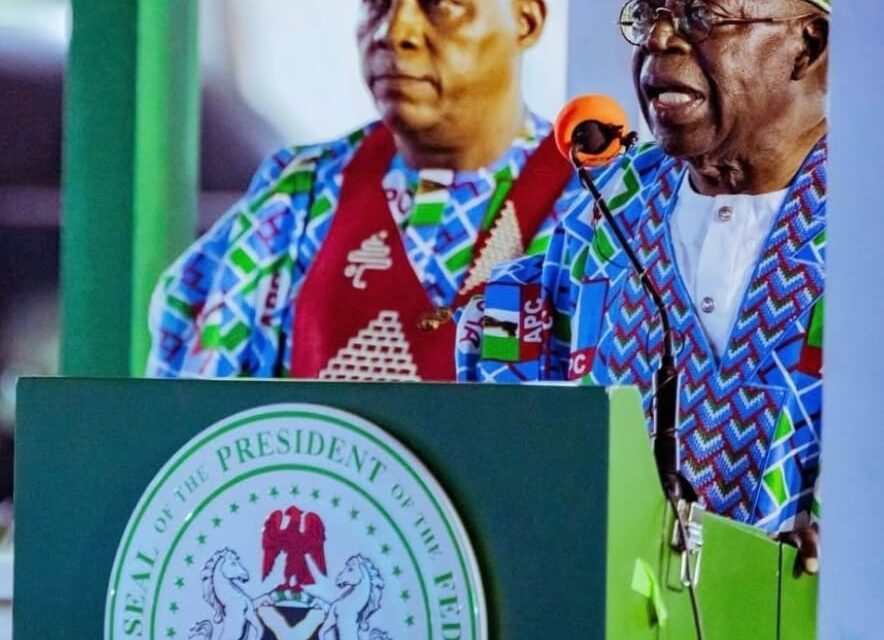

Drawing a sharp distinction between populist promises and sustainable development, President Bola Ahmed Tinubu has firmly ruled out any return to the fuel subsidy regime, framing the policy shift as a vital pivot toward empowering farmers, building critical infrastructure, and investing in the nation’s youth.
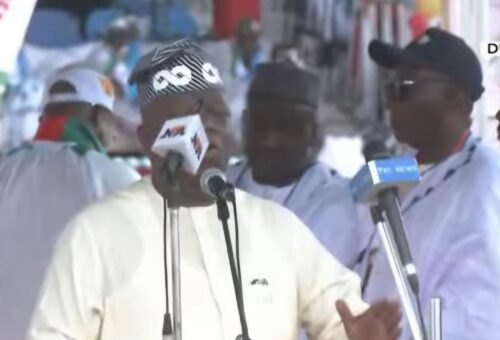
Addressing an enthusiastic crowd of supporters at the All Progressives Congress (APC) rally in Dutse, the President cautioned against political rhetoric suggesting a restoration of the old system. “Don’t let them lie to you. Subsidy is not coming back,” he declared, emphasizing that no responsible administration could continue bankrolling an open-ended consumption subsidy that drained public coffers while mortgaging the future.
Instead of reviving a regime that favored few at the expense of national development, President Tinubu reiterated his administration’s focus on direct, productive investments. He pledged that public resources would continue to be channeled into subsidizing agricultural inputs, expanding rural road networks, providing interest-free loans to farmers, and creating opportunities for young Nigerians.
Grounded in Action: Jigawa’s Agricultural Transformation
The President’s message resonated deeply in Jigawa State, an agrarian powerhouse that has already felt the positive impacts of federal and state collaboration. Recent interventions in the state include large-scale dry-season wheat farming, irrigation schemes, date-palm development, and the distribution of advanced farm machinery.
Complementing these federal efforts, Governor Umar Namadi’s administration has rolled out a robust mechanization drive featuring hundreds of tractors, combine harvesters, boom sprayers, and seeders. Coupled with ongoing road rehabilitation linking remote farming communities to major markets, these initiatives provide a practical blueprint for the President’s preference for targeted production support over a blanket subsidy.
The Fiscal Dividend of Reform
The capacity to fund these transformative projects traces back to the bold economic reforms of 2023, notably the removal of the fuel subsidy and the unification of the exchange rate. These decisions plugged massive fiscal leakages and significantly boosted Federation Account allocations. States like Jigawa have leveraged these increased revenues to scale up capital investments in agriculture, infrastructure, skills acquisition, and basic services.
Rather than viewing the reforms through an abstract lens, residents at the Dutse rally witnessed tangible proof during the visit, which featured the commissioning of new skills acquisition facilities and the unveiling of fresh agricultural equipment. For the crowd, the choice was clear: a continuation of targeted investments that build lasting productive capacity, or a return to an unsustainable past.
Looking Ahead to 2027
President Tinubu’s Dutse declaration successfully bridged macro-level economic reforms with grassroots reality. By locking in support for farmers, infrastructure, and youth development, the administration has laid out a clear alternative path for Nigeria’s economic future.
With visible projects transforming the agrarian landscape and driving local productivity, the people of Jigawa have signaled their strong backing. As January 2027 approaches, voters stand poised to re-elect President Bola Ahmed Tinubu and all APC candidates, ensuring that the current trajectory of growth, food security, and infrastructural renewal remains firmly on track.