
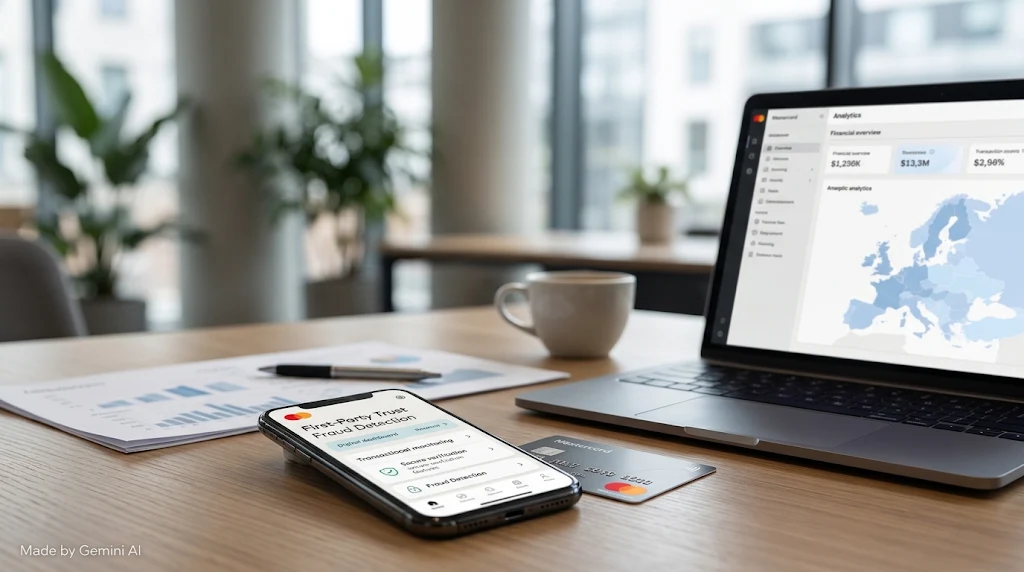

Mastercard has introduced the European enlargement of its First-Party Trust programme, which is designed to assist retailers and card issuers distinguish real third-party fraud from first-party misuse, the apply generally known as “friendly fraud” the place a cardholder disputes a official buy both intentionally or as a result of they fail to recognise a transaction on their assertion.
The rollout covers Eastern Europe, the Middle East and Africa from October 2026, with full European availability scheduled for July 2027. The programme had already been dwell within the United States, Canada, Latin America, the Caribbean and Asia Pacific since 2024.
How the programme works

First-Party Trust operates by two parallel mechanisms. The first feeds Mastercard’s fraud-risk fashions into the authorisation stream, producing alerts that flag transactions most per third-party fraud and tag these carrying increased ranges of transactional belief. The second permits retailers to submit supporting proof through the dispute course of, together with particulars of supply, authentication and buy historical past, enabling issuers to make a extra granular dedication about whether or not a chargeback declare is official.
Merchants who meet the programme’s evidence-sharing necessities obtain chargeback safety on qualifying disputes, making a direct business incentive to take part. Small companies are explicitly included within the scope, which is a significant element on condition that chargeback prices are proportionally heavier for lower-volume retailers.
Michele Centemero, govt vice chairman of companies Europe at Mastercard, mentioned: “By helping merchants and issuers access relevant transaction information needed to review disputed purchases, we can reduce unnecessary disputes while strengthening confidence across the payments ecosystem.”
Market context
The business stress underlying the programme is substantial. Global chargeback quantity is forecast to attain 324 million transactions in 2028, up from a 2025 estimate of 261 million, in accordance to the Merchant Risk Council. That trajectory displays each the continued development of card-not-present commerce and a documented rise in deliberate first-party misuse, which trade estimates have lengthy prompt accounts for a significant share of whole dispute quantity however is tough to separate from real fraud in standard dispute workflows.
The European funds panorama provides a regulatory dimension. The EU’s revised Payment Services Directive (PSD2) and its successor PSD3 place particular obligations on issuers and fee service suppliers round fraud legal responsibility and dispute decision. Any tooling that improves the evidential foundation for issuer selections carries compliance worth past the business case alone. Merchants working below Strong Customer Authentication guidelines already generate authentication knowledge that the First-Party Trust framework can repurpose as compelling proof, which reduces the incremental burden of participation.
Visa has lengthy maintained its personal dispute-resolution and chargeback administration infrastructure, together with Visa Resolve Online and the Compelling Evidence 3.0 framework it launched in 2023. Mastercard’s enlargement brings First-Party Trust broadly into alignment with what the competing community presents retailers and issuers by way of structured proof submission. The aggressive dynamic signifies that issuers managing each Mastercard and Visa portfolios will now have analogous, although not an identical, instruments throughout their card books, which simplifies inside workflows even when it doesn’t get rid of complexity.
The sensible take a look at for the European rollout can be adoption charges amongst acquirers and their service provider bases. Network programmes of this type require acquirer buy-in to floor cleanly in service provider integrations, and the July 2027 basic availability date offers acquirers roughly 9 months from now to construct or replace their dispute-handling flows.
AI stage 1 of 5: written by Darlyn Ho; AI helped with tone, construction or wording; edited and signed off by Mark Walker, Editorial Director. What the levels mean