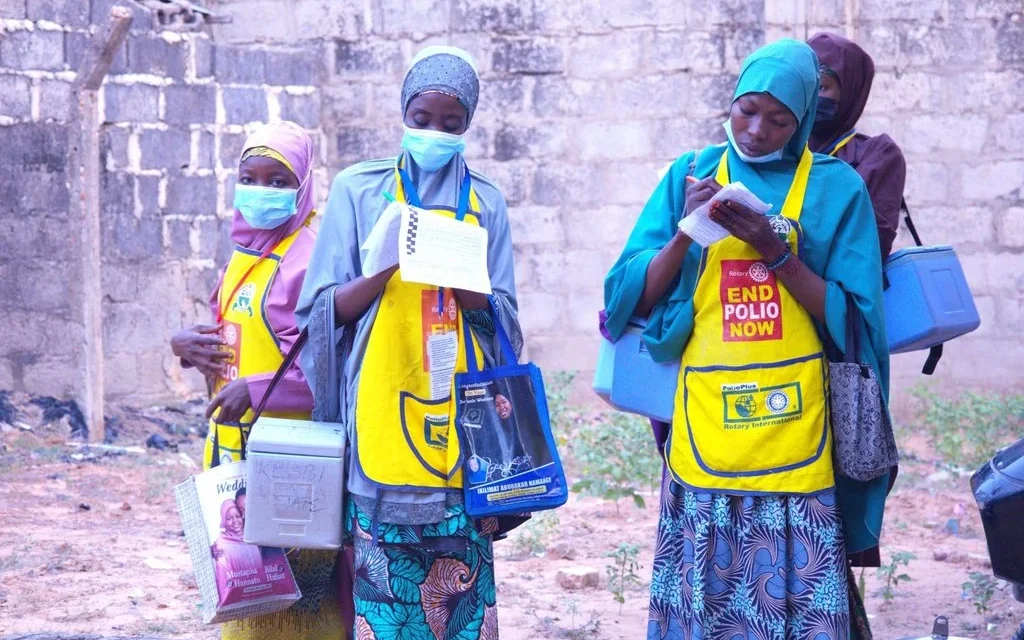
Getting a vaccine to a toddler begins lengthy earlier than anybody hundreds a chilly field. It begins with understanding the kid’s neighborhood exists.
About 2.1 million Nigerian children, representing 24% of the nation’s estimated 8.7 million under-one inhabitants, had not acquired a single routine vaccine dose, in accordance to the United Nations Children’s Fund (UNICEF). The 2023 estimate made Nigeria the nation with the best variety of zero-dose kids globally.
Some reside in distant settlements reduce off from well being amenities by tough terrain and lengthy distances. Others reside in conflict-affected communities or settlements lacking from the maps and inhabitants estimates used to plan campaigns. Without dependable details about the place folks reside and the way to attain them, well being authorities threat excluding them from vaccination campaigns.
For greater than a decade, eHealth Africa, a non-profit growing data-driven options for well being techniques, has supported Nigeria’s immunisation programmes via geospatial settlement mapping, digital marketing campaign planning with PlanFeld and vaccine supply monitoring. In the primary half of 2026 alone, vaccination campaigns supported by the organisation reached more than 23 million children across over 205,000 settlements in Nigeria, in accordance to its 2026 Mid-Year Report. But these instruments will solely endure if Nigerian establishments can fund, function and preserve them.
Finding communities the well being system can’t see
Before digital instruments turned a part of immunisation planning, programmes relied on conventional management constructions to determine and attain communities. Abubakar Shehu, who leads eHealth Africa’s Disease Prevention and Monitoring interventions, says networks linked paramount rulers to smaller communities via subordinate leaders, extending to particular person settlements.
“No matter how small a community is in northern Nigeria, they have a leader, and that leader is as important to us as somebody within the traditional system,” Shehu says.
In a 2021 publication, UNICEF said Nigeria’s immunisation programme relied on a number of paper-based registries to file maternal and little one well being info. Delays in getting these data to decision-makers, alongside handbook information assortment and evaluation, contributed to kids lacking campaigns, notably in hard-to-reach, conflict-affected and urban-poor communities.
For eHealth Africa, one response was to enhance settlement mapping. “We’ve gone from hand-drawn maps to GIS maps. So it has helped us to be able to correctly identify the settlements and the missed communities in the field,” Nnenna Ohaeri, venture supervisor at eHealth Africa who was concerned in growing its digital microplanning programme, stated.
The organisation’s geospatial work collects details about settlements, together with their places, habitation standing, accessibility, neighborhood management and public facilities comparable to colleges, markets, church buildings and mosques.
But understanding the place a settlement is doesn’t at all times imply the native authorities liable for it will probably attain it simply. Shehu describes communities that fall inside one native authorities space however are extra accessible from one other as a result of a river separates them from the primary. In such instances, vaccination groups from the neighbouring native authorities can attain the settlement, whereas the related data are transferred to the native authorities liable for it.
“Having the technological details of the locations where the people are residing is different, and also accessing the community is different,” Shehu stated.
Geospatial monitoring additionally helps eHealth Africa determine settlements vaccination groups have missed. Shehu stated the organisation started using the expertise to observe vaccination groups after administrative stories confirmed 100% protection at the same time as outbreaks continued.
“When we started using it in Nigeria, we discovered that the actual geographical coverage is far lower than what has been reported by the administrative data,” he stated.
Knowing the place communities are and the way to attain them is solely step one. Health authorities should additionally translate that info into vaccination plans, schedules and crew assignments.
Turning settlement information into vaccination plans
To handle planning challenges, eHealth Africa developed PlanFeld, a digital software that generates microplans and every day implementation plans for vaccination groups.
Conventional microplanning might take 4 to 5 days per native authorities space, generally stretching to 10. It additionally required cash for refreshments and employed personnel, Shehu stated. With a restricted well being workforce, he argued, taking well being staff away from their duties for days to plan campaigns was inefficient.
“We were able to reduce the turnaround time of the microplanning from maybe five days in some instances, even up to 10 days, to between five and 10 minutes,” Shehu stated.
PlanFeld generates every day implementation plans alongside the broader microplan, eradicating the necessity for well being staff to return to ward stage to put together assignments. It shops settlement info in a single repository and allocates workloads to groups, serving to forestall omissions of sub-settlements underneath handbook planning, Shehu stated.
Ohaeri stated PlanFeld had additionally diminished the funds allotted to microplanning, creating financial savings for presidency. “We have reduced the number of funds that are usually allocated for that process. So we have been able to have some cost savings for the government,” she stated.
The plans rely on dependable information. Shehu stated eHealth Africa and different polio eradication companions validate settlement info each two months with neighborhood leaders, native authorities officers and programme companions. This is particularly essential in northern Nigeria, the place insecurity can change whether or not settlements are inhabited between campaigns. The up to date info feeds into PlanFeld.
eHealth Africa examined the software’s team-allocation strategy in Kebbi State, which had repeatedly complained that it lacked sufficient groups to immunise the variety of kids it wanted to. After observing three marketing campaign rounds, the organisation launched the digital microplan within the fourth.
The train discovered Kebbi wanted solely seven extra groups, lower than 5% of its present whole. The greater downside was the uneven distribution of groups throughout native governments.
“There are some local governments that have several teams that are beyond what they needed, and there are some that have fewer than they needed,” Shehu defined. “We were able to do rationalisation within the state, and that significantly reduced the number of settlements that were being missed during the implementation.”
Shehu stated the proportion of settlements deliberate for vaccination however missed throughout implementation fell from greater than 20% in an noticed marketing campaign to round 6% in a subsequent spherical using the digital microplan.
Once vaccination groups have their assignments, the subsequent problem is getting vaccines to the amenities they serve.

Getting vaccines to the final mile
eHealth Africa stated it helps a push mannequin of vaccine supply, accumulating vaccine commodities from state central medical shops and transporting them to well being amenities. The organisation makes use of geospatial expertise to plan supply routes, serving to officers attain amenities whereas managing time and logistics prices.
“Logistics is always difficult to handle, but if you have a system in place to support the delivery model that you are using, it tends to make it easier,” Shehu stated.
eHealth Africa’s Logistics Management Information System (LoMIS) helps deliveries by giving well being authorities visibility into vaccine actions and facility inventory ranges. State and native authorities immunisation officers can observe vaccines in transit, determine amenities needing replenishment and redistribute extra inventory to amenities dealing with shortages.
“From the comfort of the office of the state control officer, you’ll have visibility in terms of the location of every vaccine,” Shehu stated.
Delays in receiving facility-level information can gradual state choices about the place vaccines are wanted.
“If your data is coming to the state level late, it will delay decision-making. And when you delay decision-making, the program tends to suffer,” Shehu stated.
Vaccine shortages can even undermine demand. Shehu stated caregivers turned away as a result of a facility has run out of inventory usually don’t return.
“Despite all the effort being put into the demand side, if vaccines are not available at the facility, caregivers who bring their children for immunisation may be asked to return another day. In most cases, they will not come back,” Shehu stated.
The programme additionally handles reverse logistics: eHealth Africa collects vaccine waste from well being amenities and transports it to a central level for incineration, Shehu stated.
When autos can’t attain a facility, a consultant might meet a supply officer at an accessible central location to acquire vaccines, Shehu stated.
In Sokoto State, eHealth Africa’s 2026 mid-year report stated the variety of well being amenities served via its Vaccine Direct Delivery intervention elevated from 351 to 407. The programme additionally delivered roughly 3.41 million vaccine antigens within the state throughout the first half of 2026 to help immunisation providers in underserved communities.
In Borno State, eHealth Africa stated it makes use of Indigo Vaccine Carriers to help immunisation in communities affected by insecurity. The carriers preserve vaccines at +2°C to +8°C for up to 5 days with out ice or electrical energy. Since 2021, the organisation says Indigo techniques have immunised more than 496,000 children.
“Facilities using Indigo have cut transport costs by 50%, moved from two sessions a week to daily services, and are reaching almost twice as many children compared to ice-pack carriers,” Tahir Buhari, senior analysis supervisor at eHealth Africa, stated.
Keeping vaccines potent at well being amenities
Getting vaccines to well being centres is solely a part of the problem; preserving them potent is one other, notably with Nigeria’s unreliable electrical energy provide.
“If you expose some of the vaccines and they freeze, they are damaged. If you expose them to temperatures above eight degrees Celsius, they are damaged. So what that means is you have to have a constant way of powering your refrigerators to keep your vaccines potent,” Shehu stated.
With help from UNICEF, eHealth Africa stated it has put in solar energy techniques at main healthcare centres via its Renewable Energy for Primary Healthcare (RE4PHC) programme. Shehu stated the intervention improved service supply at solarised amenities, notably in maternal and new child healthcare, with a rise within the variety of deliveries carried out at some main healthcare centres.
The organisation additionally remotely displays the techniques to detect faults and ship technicians to affected amenities. “So it’s a smart system that is beyond just providing electricity,” Shehu stated.
According to eHealth Africa’s 2026 mid-year report, the organisation had solarised 238 main healthcare centres throughout 12 states. In the primary half of 2026, 226 remotely monitored amenities generated 277,800 kWh of electrical energy, avoiding an estimated ₦166 million in gasoline prices.
Building techniques that may outlast tasks
Immunisation techniques rely not solely on expertise but additionally on folks to function them, assets to preserve them and funding to maintain them working. Shehu recognized restricted technical capability, excessive upfront prices and donor dependence as main sustainability challenges.
“There are some systems that work in advanced countries, but if you bring them into the Nigerian context or an African context, we don’t have the capacity to manage them at the initial stage,” he stated.
He stated sustainability have to be thought of earlier than deployment, with authorities and meant customers concerned from the design stage, notably given the price of introducing applied sciences and sustaining them after donor funding ends.
“If you want sustainability in all your interventions, the first thing you need to do is consider human-centred design, designing with the government as well as the beneficiaries,” he stated.
Technology companions should additionally take into account what governments would spend to develop, deploy and function techniques after exterior help ends, Shehu stated.
“Why most of the technology innovations are failing is because we focus more on designing and implementing them, but we don’t take into consideration how much it will cost for the government to continue running that intervention after our exit,” he stated.
Ohaeri confused the necessity for home funding to maintain these programmes. Under the 2001 Abuja Declaration, African governments dedicated to allocating at the least 15% of their annual budgets to healthcare, however Nigeria has but to meet that focus on, she stated.
“With the Abuja Declaration of 2001, we agreed on a 15% investment, but I don’t think that Nigeria has ever gone beyond 5%,” she stated.
She added that governments should additionally construct the capability of native well being staff to proceed using these instruments and enhancing healthcare supply with out counting on donor or worldwide companion help.
This infrastructure might additionally help maternal, new child and little one well being, illness surveillance, emergency preparedness, and sexual and reproductive well being providers, Shehu stated.
Governments would want to coordinate digital well being investments, set up frequent information requirements and make platforms interoperable to keep away from disconnected techniques, he stated.
“Ultimately, Africa does not simply need more digital health platforms. We need connected, sustainable and people-centred systems that translate reliable data into better decisions, stronger service delivery and equitable access to healthcare,” he stated.